
If your product breaks down in sunlight or bright store lighting, the container itself is part of the formulation. Essential oils, tinctures, serums, supplements, and specialty foods can lose potency, change color, or develop off-flavors when UV and visible light trigger oxidation and photodegradation inside the package. The two most common defenses are amber glass and UV-blocking plastic, and picking between them affects cost, shelf life, shipping weight, and how the product looks on a shelf.
This guide breaks down how each option actually blocks light, where each one falls short, and how to decide which fits your product, budget, and packaging line.
Quick Answer
Amber glass is the more reliable choice for maximum light protection because its color comes from iron and sulfur compounds fused into the glass itself, giving consistent blocking of UV and violet-blue light across the container. UV-blocking plastic (clear PET or HDPE with UV additives, or opaque/pigmented resin) can get close to that protection level, costs less, weighs less, and ships more efficiently — but protection depends on the specific additive package and resin thickness, so it needs to be verified rather than assumed.
How Each Material Actually Blocks Light
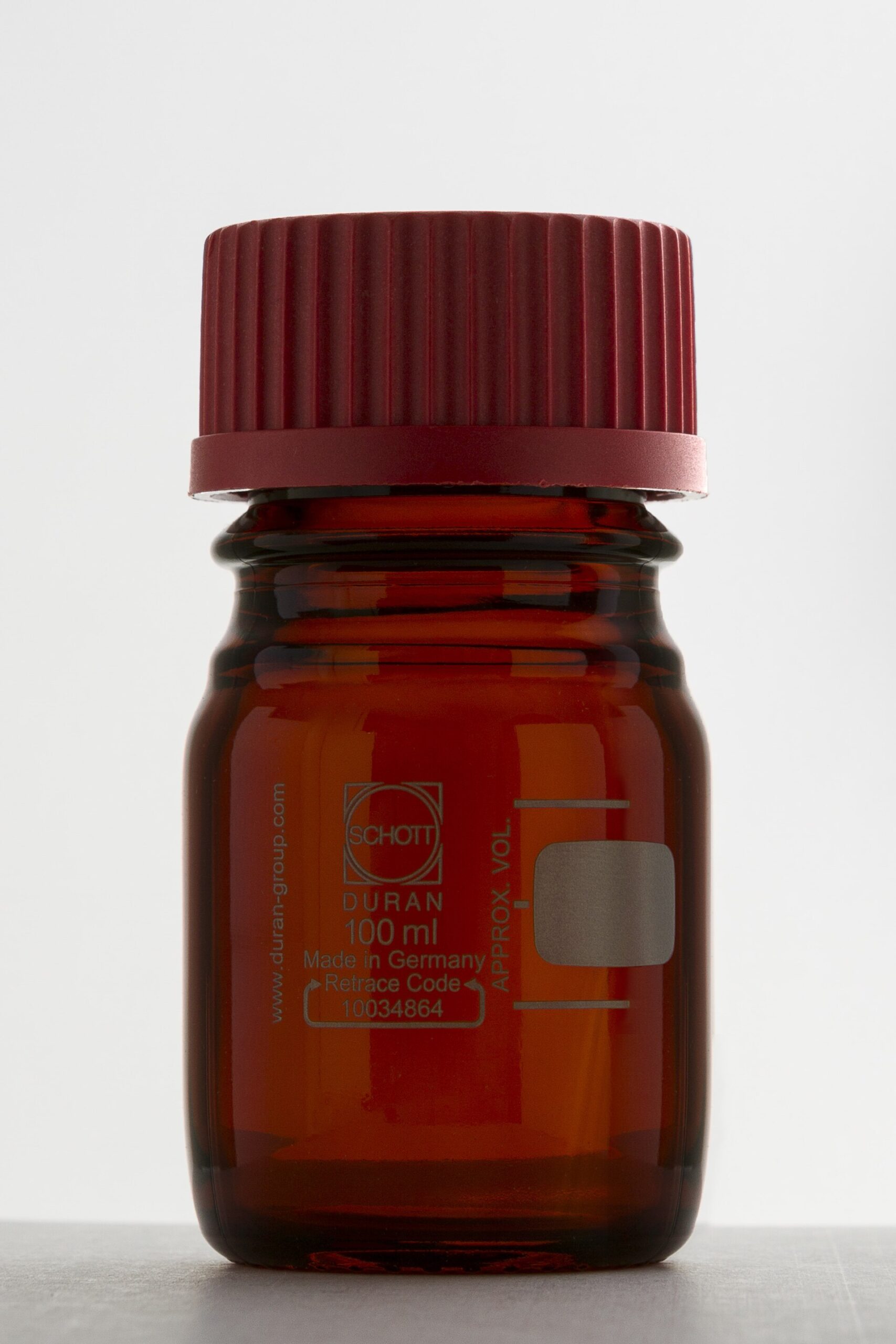
Amber glass gets its color and its function from metal oxide compounds (primarily iron and sulfur) melted into the glass batch. This shifts the glass’s transmission curve so it absorbs most light in the UV and near-UV range roughly between 290 and 450 nanometers — the band most responsible for triggering oxidation, color fading, and breakdown of light-sensitive compounds like essential oil terpenes, certain vitamins, and some active pharmaceutical ingredients. Because the color is part of the glass matrix, protection doesn’t wear off, scratch away, or vary between manufacturing runs the way a coating might.
Plastic containers get UV protection one of three ways: pigmenting the resin so it’s opaque (white HDPE with titanium dioxide is common for over-the-counter drugs), tinting clear resin amber or brown, or adding UV-absorbing compounds like benzotriazoles or hindered amine light stabilizers (HALS) to otherwise clear PET or HDPE. Untreated clear PET is a weak barrier — it blocks some UV-B but lets a meaningful amount of UV-A through — so an amber PET bottle without the right additive load won’t necessarily match amber glass. The industry benchmark here is USP <671> spectral transmission testing, and it does not use one flat number for all plastic. For containers intended for oral or topical products, it caps light-resistant plastic at no more than 10% transmission at any wavelength between 290–450 nm, regardless of container size. Parenteral (injectable) containers are held to a separate, size-based limit table instead: the allowable transmission is higher for very small containers and steps down as volume increases — around 50% for a 1 mL container, tightening through the mid-size range down to 15% for containers of 50 mL or larger. In other words, there’s no single blanket percentage for ‘plastic’ — the limit depends on how the product is administered and, for injectables, how big the container is.
Practically, this means a container’s color alone doesn’t guarantee performance. Two amber bottles that look identical on a shelf can transmit very different amounts of UV depending on the glass composition or the plastic’s additive concentration. If light protection is a real specification for your product (not just a design choice), ask suppliers for spectral transmission data, not just a Pantone match.
Cost, Weight, and Practical Tradeoffs
Amber glass typically costs more per unit than comparable plastic and adds meaningful shipping weight, which matters for e-commerce brands paying dimensional or weight-based freight. It’s also more fragile in transit, so it usually needs more protective packaging inside the shipping box. On the upside, glass doesn’t interact chemically with most oils, acids, or actives the way some plastics can over long shelf life, and both amber and clear glass are widely recyclable through standard municipal streams (though colored glass sometimes needs separate sorting).
UV-blocking plastic is lighter, cheaper to mold and ship, and far more resistant to breakage — a real advantage for subscription boxes, travel-size products, or anything sold through channels with rough handling. The tradeoff is that protection depends entirely on the additive package the manufacturer used, and that additive can degrade slightly over the container’s own shelf life or with repeated UV exposure before it’s even filled. Recyclability also varies more: pigmented or multi-layer UV-blocking plastics are sometimes harder for municipal recycling programs to sort than a single clear or amber resin.
A middle option many brands overlook: amber or UV-blocking plastic combined with secondary packaging (a printed carton or sleeve) that blocks all light until the product is opened and in active use. This can let you use a lighter, cheaper primary container while still hitting strong light-protection targets for the bulk of the product’s shelf life.
Tips and Common Mistakes
Don’t assume ‘amber’ equals ‘protected.’ Ask any glass or plastic supplier for actual spectral transmission data (ideally tested against USP <671> or an equivalent standard) rather than relying on color alone, especially for plastic where additive levels vary by vendor and even by production lot.
Match the protection to the actual sensitivity of your product. A product that mainly needs protection from direct sunlight and window display light has different requirements than an active pharmaceutical ingredient that degrades under normal indoor lighting — don’t over-spec (and overpay for) glass if a well-formulated UV-blocking plastic or an opaque container plus a light-blocking secondary package will do the job.
Watch for the ‘invisible until it’s too late’ failure mode: light damage often shows up as color change, cloudiness, or reduced potency well after the product has shipped and can’t be recalled cheaply, so testing a new container option on real product over its full intended shelf life (not just a quick shelf test) is worth the delay before a full production run.
If you switch from glass to plastic (or the reverse) for cost or supply-chain reasons, re-run stability testing rather than assuming the new container performs the same — resin suppliers change additive formulations, and glass compositions can vary between glassmakers even within the same nominal color.
Explore more: more packaging materials guides.
Amber Glass vs UV-Blocking Packaging FAQs
Does amber glass block 100% of UV light?
No. Amber glass blocks the large majority of light in the 290–450 nm range where UV and near-UV damage is concentrated, but it doesn’t block all wavelengths completely. That’s why light-sensitive products stored in amber glass should still be kept out of direct, prolonged sunlight.
Is amber PET plastic as protective as amber glass?
It can come close, but only if the resin has enough UV-blocking additive or pigment load — amber-tinted PET without added UV stabilizers is a weaker barrier than amber glass. Check spectral transmission data rather than assuming color alone provides equivalent protection.
Which is better for essential oils and tinctures?
Amber (or cobalt/violet) glass is the traditional standard for essential oils and tinctures because glass is also chemically inert to concentrated oils and alcohol-based extracts, which can interact with some plastics over time. UV-blocking plastic is a reasonable option for lower-concentration or shorter-shelf-life products where weight and breakage are bigger concerns.
Can I use clear packaging with a UV-blocking secondary carton instead?
Yes. A printed box, sleeve, or pouch that fully blocks light works well for products that only need protection during storage and shipping, letting you use a lighter or cheaper primary container while the product is sealed and not in active use.
What standard should I ask suppliers about for light-resistant packaging?
USP <671> spectral transmission testing is the common reference point in the US, and it doesn’t use one flat percentage for all plastic. It caps light-resistant containers for oral or topical products at no more than 10% light transmission between 290–450 nm regardless of size. For parenteral (injectable) containers, it instead uses a separate, size-based limit table — allowable transmission runs higher for very small containers (around 50% at 1 mL) and steps down to 15% for containers of 50 mL and larger. Ask suppliers whether their container has been tested against it, even if your product isn’t a regulated pharmaceutical.
Find the Right Packaging Supplier
Search the free Packaura supplier directory — filter by material, certification, and location to find vetted suppliers. Search the Supplier Directory.
Want packaging news in your inbox? Subscribe to the free newsletter.
Photo: Hiart / CC0, via Wikimedia Commons.