
If you ship anything the Department of Transportation considers a hazardous material, the box or drum it travels in usually can’t just be sturdy — it has to carry a specific UN specification mark proving it passed government-mandated drop, stack, and leak testing for that category of goods. That stamped code on the side of a fiberboard box or steel drum looks like a jumble of letters and numbers, but it’s actually a compact spec sheet.
This guide breaks down what UN-rated packaging is, how to read the marking on a box or drum, the most common types you’ll run into, and the mistakes that get shipments rejected or recalled at the dock.
Quick Answer
UN-rated (or “UN-spec”) hazmat packaging is packaging that has been tested and certified under the UN Model Regulations and, in the U.S., 49 CFR Part 178 to safely contain a specific category of dangerous goods during transport. The stamped code on the package — like 4G/Y145/S/26/USA/M1234 or 1A2/Y1.4/150 — tells you the packaging type, material, performance level, and testing details, and it must match the packing group and hazard class of what you’re shipping.
How to Read the UN Marking
Every UN-spec package is stamped with a string of codes in a fixed order, and once you know the pattern it reads like a sentence. The first part is the packaging identification code: a number for the container type (1 = drum, 2 = barrel, 3 = jerrican, 4 = box, 5 = bag, 6 = composite packaging) followed by a letter for the material (A = steel, B = aluminum, C = natural wood, D = plywood, G = fiberboard, H = plastic, L = textile, M = paper). A second number, when present, tells you the head type — 1 means a non-removable (tight) head, 2 means a removable (open) head. So 1A2 is an open-head steel drum, and 1H1 is a tight-head plastic drum built for liquids.
Next comes the performance level letter: X, Y, or Z. X-rated packaging has passed the toughest tests and can carry Packing Group I, II, or III materials (the most hazardous down to the least). Y-rated packaging is limited to Packing Group II and III, and Z-rated packaging only covers Packing Group III, the mildest hazard tier. After that you’ll see either a maximum gross mass in kilograms (for boxes and solids) or a specific gravity figure and hydrostatic test pressure in kPa (for drums holding liquids), followed by the last two digits of the manufacture year, the country code that authorized the mark, and a manufacturer or approval-agency symbol.
Put together, a code like 4G/Y145/S/26/USA/M1234 means: a fiberboard box (4G), rated for Packing Group II or III (Y), approved to hold up to 145 kg of solids or inner packagings (S), made in 2026, certified in the USA, by manufacturer M1234.
Common Box and Drum Types
Fiberboard boxes (4G) are the standard choice for shipping hazmat in combination packaging — meaning glass bottles, plastic jugs, or metal cans packed with cushioning inside a single outer box. They’re inexpensive and widely stocked, but the inner packagings and cushioning must match exactly what was used in the box’s original test certification; swapping in a different bottle size or less padding can invalidate the rating.
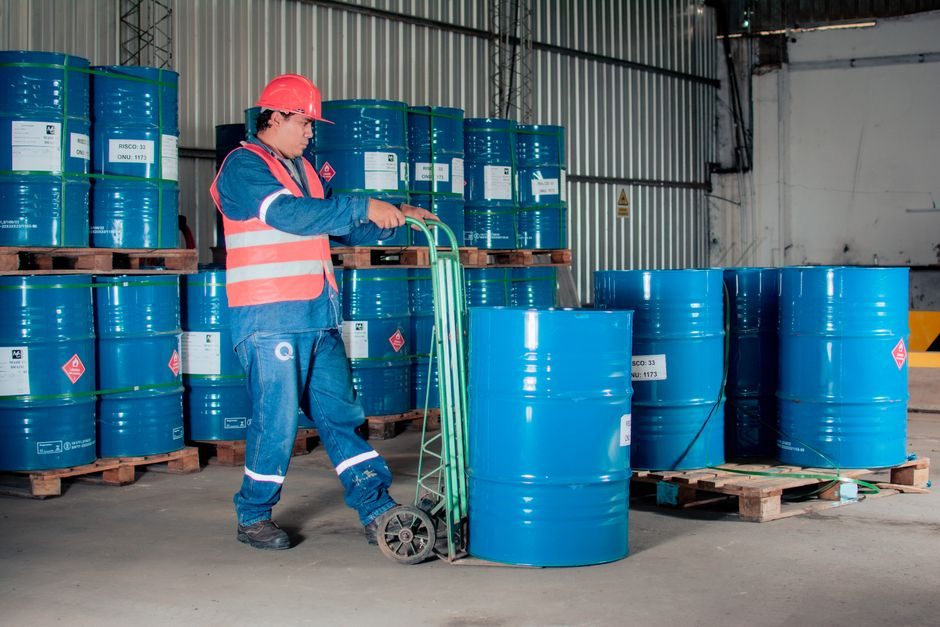
Steel and plastic drums come in two flavors: tight-head (1A1, 1H1) for liquids that don’t need to be poured or scooped out easily, and open-head (1A2, 1H2) with a removable lid, used for liquids that need wide-mouth access or for solids and pastes. Steel drums generally handle a wider range of chemical compatibility and higher specific gravity liquids, while plastic (HDPE) drums are lighter and resist corrosion from certain acids and salts — but check the drum’s rated specific gravity against the actual density of what you’re filling it with, not just the volume.
Composite packagings use a two-letter code: the first letter is the inner receptacle’s material and the second is the outer packaging’s material, almost always a plastic inner receptacle (H) inside a protective outer. A 6HA1 is a plastic receptacle inside a steel drum, a 6HA2 is a plastic receptacle inside a steel crate or box, and a 6HG1 is a plastic receptacle inside a fiber drum. These and intermediate bulk containers show up for larger volumes, while straight fiber drums (1G) are a lighter-weight option for solids and powders that don’t need the strength of steel or plastic.

Tips / Common Mistakes
Match the performance level to your packing group, not just the hazard class — an X-rated drum is more than enough for a Packing Group III material, but a Z-rated box is not legal for anything in Packing Group I or II, even if it seems physically sturdy enough. Always check the drum’s rated specific gravity against your liquid’s actual density; a drum tested at 1.2 specific gravity isn’t automatically safe for a denser 1.6 chemical even if it fits volume-wise. Never mix and match components from different tested configurations — the box, inner packaging, and cushioning (or the drum, gasket, and closure) were certified together as a system, and substituting pieces voids the certification. Reconditioned steel and plastic drums are legal to reuse, but only when reconditioned and retested by a facility registered for that service, with fresh markings applied — don’t reuse a drum with an old code and assume it’s still valid. Finally, keep closure instructions (torque specs, gasket type, number of turns) on file, since most packaging test failures in the field trace back to improper closure rather than a bad box or drum.
Explore more: More hazmat packaging materials guides.
UN-rated hazmat packaging FAQs
What does “UN-rated” mean on a box or drum?
It means the packaging design was tested and certified to meet UN Model Regulations and, in the U.S., 49 CFR Part 178 performance standards for transporting a specific category of hazardous materials, and the result is stamped as a code on the package.
What’s the difference between X, Y, and Z packaging ratings?
X-rated packaging passed the strictest tests and can ship Packing Group I, II, or III materials. Y-rated packaging is limited to Packing Group II and III. Z-rated packaging can only be used for Packing Group III, the least hazardous tier.
Can I reuse a UN-rated drum for a different chemical?
Only if the new chemical’s hazard class, packing group, and specific gravity (for liquids) fall within what the drum’s existing certification covers, and the drum shows no damage. When in doubt, have it reconditioned and retested by a certified facility before reuse.
Find the Right Packaging Supplier
Search the free Packaura supplier directory — filter by material, certification, and location to find vetted suppliers. Search the Supplier Directory.
Want packaging news in your inbox? Subscribe to the free newsletter.
Photo by Ghasiq Anjum on Pexels.